Since 2009 · In-house electronics and firmware
Load cells, transmitters and firmware — engineered, calibrated and documented for engineers who build weighing systems.
Strain gauge load cells from 50 g to 200 t, transmitters from mV/V to PROFINET, and the firmware that connects them. Every model ships with a full specification, a dimensional drawing, and a per-unit calibration certificate.
50 g – 200 t
Capacity range
1 piece
Sample MOQ
24 h
Quotation response
24 bit @ 4.8 kHz
Signal conversion
Find the load cell that fits your application
Six questions. Three candidates. Full specification, drawing and CAD for each. Nothing is submitted until you have seen the result.
How is the load applied?
This one decides the cell type. Getting it wrong is the most common reason a cell gets rejected at installation.
What are you weighing?
Pick the closest application. It maps directly to the mainstream cell type and capacity band.
What is the maximum load?
Enter the maximum load on a single cell. Add the vessel weight and allow headroom for shock and off-centre loading. For multi-cell systems, divide the total by the number of cells first.
What accuracy do you need?
Accuracy class is defined internationally by OIML Recommendation R 60. NTEP is the United States equivalent.
Where does it operate?
This determines the protection class and the material. A washdown zone needs IP69K and 316L — IP67 alone will not survive a chemical washdown regime.
What signal does your PLC need?
This decides whether you need a sensor or a sensor plus transmitter. A protocol mismatch means the whole system has to be redone.
Three candidates for your application
Ranked by match score. Each one links to the full specification, drawing and CAD model.
Next step
The whole signal chain, from one manufacturer
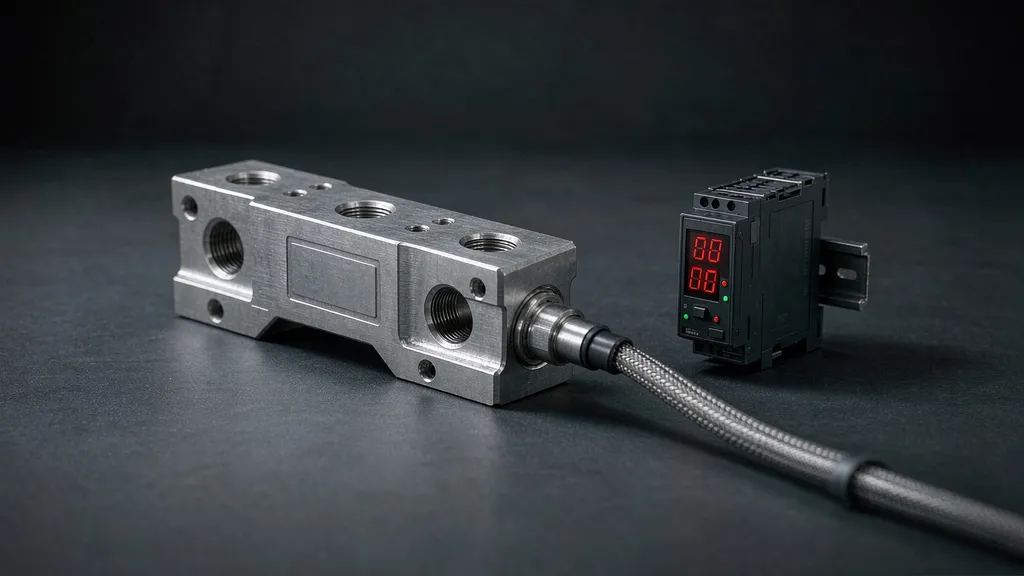
A load cell alone gives you millivolts. We build the sensor, the signal conditioning, the firmware and the cloud — so the accuracy you specify is the accuracy you get.
Why engineers switch — and why they stay
The decision is rarely about the headline price. It is about what happens in month eighteen.
From enquiry to production
Four steps, each with a defined response time.
Questions engineers ask us first
Straight answers, with the numbers that back them.
Tell us the application — we will return three candidates with the full specification.
Capacity, force direction, environment and output signal are enough for us to narrow it down. Most engineers receive a shortlist within one working day.